
Destination Stories
The White Continent: Inside Antarctica's Most Sustainable Luxury Expedition
How Swan Hellenic is redefining polar travel, one boot wash at a time!
The hotel manager aboard the SH Minerva, Mauricio, smiled when I asked what surprises guests most about dining in Antarctic waters.
"How good it actually is," he said.
Mauricio wasn't wrong.
That evening, as our Polar Class 5 expedition vessel left Ushuaia on its way through the Drake Passage toward the White Continent, I sat down to pan-seared fish with roasted vegetables and a delicate Beurre Blanc. Wine glasses stayed full with specially chosen for the meal. Linen napkins, crisply folded. The service felt more Manhattan than maritime. Outside my window, the Southern Ocean tossed and turned, restless, powerful, and mercifully calmer than it can be.
I've been on luxury and river cruises before, but I'd never experienced an expedition cruise. This is modern Antarctic exploration: genuine luxury meets purposeful sustainability. Expedition staff, highly trained and qualified naturalists, mariners, specialists, outnumbered passengers on our voyage. Every decision, from route navigation to menu planning, reflects a deep responsibility to protect Earth's last great wilderness while providing the best experience possible for all the passengers. Mission accomplished.
The Vessel: Purpose-Built for the Impossible
SH Minerva isn't a traditional cruise ship retrofitted for adventure. She is part of a fleet of three, joined by her sisters, the SH Vega and SH Diana. The Minerva is a purpose-built expedition vessel designed specifically for polar conditions, with a Polar Class 5 ice-strengthened hull that can operate year-round in medium-thickness sea ice.
Those oversized stabilizers extending from each side? Each is mounted on an independent gyroscopic system that cancels out 70–80% of the ship's movement, critical technology when crossing some of the roughest waters on the planet.
By the numbers: 115 meters long, accommodating just 152 passengers supported by roughly 122 crew members. That near 1:1 ratio isn't indulgent, it's essential. Our voyage had just 90 passengers and 118 crew, allowing for exceptional safety, flexibility, and personal attention.
But statistics only tell part of the story.
When Captain Svein-Rune Strømnes reviewed real-time weather data from the Wärtsilä Transas navigation systems and adjusted the Minerva’s course to skirt a developing weather system, what could have been a classic "Drake Shake" became a manageable crossing. We arrived early, earning an unexpected evening bonus landing on Barrientos Islands. That's when I realized: expertise didn't just mitigate risk, it created opportunity.
That First Iceberg
Our captain, who'd spent decades with a major cruise line before joining Swan Hellenic, told me one thing never gets old: the first iceberg sighting.
We even had a friendly onboard game guessing the exact moment it would appear.
When that massive blue-white sentinel came into view, proof we'd crossed the Drake and Antarctica lay ahead, the swell of delight moved through the ship. As we stood by the Swan’s Nest, the captain smiled from the bridge, even by something he'd seen hundreds of times.
Swan Hellenic was doing something right. They weren't manufacturing an experience; they were enabling genuine connection with one of Earth's most extraordinary places.
That's the base of expedition cruising with Swan Hellenic: professionals who never lose their sense of wonder, technology deployed with humility, and environmental stewardship that goes far beyond words.
A Floating Boutique Hotel at the End of the Earth
Inside, the Minerva feels less like a ship and more like an attractively designed boutique hotel that happens to sail through one of the most beautiful places on the planet.
Unobstructed views flood the public spaces. There's a spa, gym, sophisticated, but comfortable lounges filled daily with happy passengers, and a charismatic dining setting. My balcony stateroom featured a cozy double bed, comfortable living area, flame-effect fireplace (my personal favorite), and a suitable bathroom, creating an indulgent retreat after fun filled days in polar gear, which I looked forward to each evening.
But here's what really mattered: after spending hours on deck in wind and salt spray, watching gentoo penguins toboggan down icy slopes or viewing the beauty of the ice from the Zodiacs, I could return to a space that felt warm and cozy. Not everyone needs that. Some travelers want spartan expedition ships where discomfort is part of the story. Not me. Give me rugged outdoor adventure all day long, but my evening comfort is of supreme importance, and I didn't realize how much I'd appreciate it until I was there.
Fine Dining at the End of the Earth
Behind the sophistication of the dining room lies a logistical achievement.
Every provision, Argentine beef, fresh produce, delicate ingredients, is loaded in Ushuaia before departure. The galley team plans meticulously for 10–12 days, rotating ingredients to ensure freshness and variety throughout the voyage.
"We source locally in Argentina whenever possible," Mauricio explained, supporting regional suppliers while maintaining exacting standards.
The result? Multi-course meals that rival urban restaurants. Fresh seafood. Sophisticated flavors. Delicious every single time, with ample options for every appetite. I am still visualizing that daily bread selection.
And amazing flexibility. One evening, halfway through my main course, the captain notified us of some extraordinary outdoor views. The entire dining room emptied in seconds. I grabbed my phone and ran, leaving a perfectly plated dish behind. When I returned twenty minutes later, my meal was delivered reheated, replated. No questions asked. No annoyance from staff. Just a knowing smile from my server. "We get it," she said simply.
But it was the smaller touches that revealed the team's character. The bartender noticed a few of us had become friends during the voyage and created a special signature drink just for our group, unrequested, unexpected, just because he could. These weren't scripted cruise ship gestures. This was a crew genuinely invested in making the experience memorable.
That moment crystallized something important: this wasn't a cruise ship trying to do expedition. This was an expedition ship that happened to do luxury exceptionally well. Now I understand the difference.
Dietary needs from kosher, vegetarian, vegan, gluten-free, were managed seamlessly, never as an afterthought.
But what impressed me most was what didn't happen.
Nothing, absolutely nothing, goes overboard in Antarctic waters (well except for passengers braving the polar plunge, a story for another day). All food waste, packaging, and refuse is stored and returned to Ushuaia for proper disposal. Grey water is reused where permitted. Sustainability here isn't performative; it's operational.
The Choreographed Dance of Daily Landings
Before passengers wake each morning, the real work begins.
The captain and expedition leaders evaluate ice, weather, and potential landing sites. Scouting missions determine safe approaches. The bridge coordinates anchoring and zodiac launches. Teams inspect every zodiac, fuel, safety gear, communications. Passengers are divided into color-coded groups to prevent overcrowding both in base camp (where we dressed for our expeditions) and during the landings.
Then comes biosecurity. Prior to leaving the ship for our landing the first time, biosecurity checks must be conducted of all our clothing!
My cute red hat suffered a pom-pom casualty. “You’ll need to remove the pom-pom or not wear this on the landings" Alexis told me. I must have looked confused because he explained: "The fuzz. Even synthetic fibers can be problematic if they shed in Antarctica." My other clothes, including socks were meticulously vacuumed.
That's when it clicked, this wasn't theater or checking boxes. This was genuine care for something exceptional, taken to a level I'd never experienced. If they're monitoring decorative hat pom-poms, they're serious about everything.
Boot-washing stations may seem tedious, but they're critical. Every boot, pole, and piece of gear is inspected before and after landings to prevent the introduction of seeds, soil, or microorganisms that could devastate fragile ecosystems.
Daily briefings and instructions are a matter of course. "People think we have a fixed itinerary," Miriam, the Expedition Team Leader told the group. "But decisions are made hour by hour." That flexibility matters.
"We plan a day, but it can always change, so that is why we post in on the screens in the lounge and the cabin televisions", Miriam continued "Antarctica decides what we see, not us. Our job is to read what she's offering and respond."
The Moments That Define Everything
Some experiences can't be planned, and not every experience is planned. They might be facilitated by people who know what they're doing and care enough to make them happen along with a helping hand from nature.
On our 2nd day in Antarctica, I was one of the "Lucky Ten", five kayaks, two people each, who launched with Alexis as our guide. We paddled into Antarctic waters, silent except for the dip of our paddles, the ice crunching in the water, and the distant calls of seabirds.
Then the whales came.
Not in the distance. Not breaching dramatically for photo opportunities (although that happened). They surfaced all around us, massive, graceful, impossibly close. One came right alongside my kayak, first I saw the bubbles, and I let out a tiny scream as I could see it under the water, and moments later, a spout of water appeared as it came to the surface mere feet away along with their groans and rumbles, sounds I’ll never forget.
Alexis an experienced kayaking guide had positioned us perfectly. He’d read the water, understood the whales' behavior, and given us an encounter that felt less like wildlife viewing and more like being welcomed into their world. For that magic hour, we weren't tourists. We weren't even human. We were just ten people, utterly silent, utterly present, sharing space with creatures who could have flipped our kayaks with a casual flick of their tails but chose instead to simply... be with us.
When we paddled back to the Zodiac, no one spoke. What could we possibly say? Everyone excitedly boarded for the ride back to the ship, still processing the beauty of nature we had just been a part of. It was magic. We knew how special today had been, and this was reinforced later by Alexis during our dinner conversations.
This wasn’t even the moment I'd only imagined in my pre-voyage research, which focused on seeing some penguins up close, which of course happened, but the transformative encounters that make Antarctica unlike anywhere else on Earth. But experiencing it firsthand was beyond anything I could have imagined. I still think about seeing those whales up close every day and am grateful for the encounter.
Sustainability: Far Beyond Marketing
Swan Hellenic's environmental promise runs deeper than visible practices like reusable water bottles and boot-washing stations, important as those are.
The Minerva operates under a strict zero-discharge policy in Antarctic waters. Advanced wastewater treatment systems meet the highest international standards. Ballast water is treated to prevent invasive species. Biodegradable cleaning products are used throughout. Single-use plastics have been eliminated from passenger areas.
The ship uses cleaner-burning, low-sulfur marine fuels, optimizes routes to reduce fuel consumption, and operates at efficient speeds. Dynamic positioning reduces fuel use while at anchor. LED lighting and smart climate controls adjust automatically.
Most importantly, Swan Hellenic is actively planning and investing, acknowledging the unique challenges of polar environments.
Passengers play a role too: following strict biosecurity protocols, reusing towels, minimizing water use, respecting wildlife distances, and understanding where we are.
The expedition team doesn't just drive zodiacs, they are authorities in marine biology, glaciology, ornithology, and polar history. Their briefings and educational sessions transformed how I understood Antarctica and the IAATO guidelines that govern responsible tourism.
The Invisible Dedication
Beyond moments like the kayaking encounter, much of what makes these voyages exceptional happens out of sight.
Night watches scanning for icebergs while passengers sleep. Daily crew briefings coordinating complex logistics. Crew safety drills. Constant maintenance of zodiacs, kayaks, and equipment. Medical readiness in one of the most remote environments on Earth, on our voyage by Dr. Mila, who joined landings while remaining prepared for emergencies.
Crew members work long days for many months at a time, away from family and friends. While passengers dine, expedition leaders plan tomorrow. While we sleep, the bridge navigates ice fields. What struck me most was how many crew members had worked with Swan Hellenic for years, and how genuinely proud they were of what they do. They were happy, smiling, and caring - and it was real.
Traveling to remote regions isn't about seeing them. It is about protecting them and making sure passengers are cared for in the process.
Swan Hellenic aligns with the United Nations' Sustainable Development Goals and often exceeds what is required. Their approach isn't about checking boxes; it's about long-term responsibility.
What This Means for Antarctic Travel
Antarctic tourism is growing rapidly, and that reality brings responsibility. Choosing the right company isn't just about personal comfort, it is about the collective impact we have on the continent and who does it best.
Look for IAATO membership, transparent sustainability practices, experienced expedition teams, high crew-to-passenger ratios, and demonstrated commitment beyond glossy brochures. But more than that, look for operators who understand we are all guests in one of Earth's last pristine wildernesses.
Swan Hellenic gets this at a cellular level. It's in how expedition staff speak about the continent, with respect, not ownership. It's in the captain's willingness to take a different route to avoid passenger discomfort. It's in crew members meticulously scrubbing boots for the third time in a day while happily explaining why it matters.
That is the difference.
Because if we're going to visit the White Continent of Antarctica, we have an obligation to ensure it remains pristine for generations to come.
The Drake Passage will always be unpredictable. Icebergs will always be breathtaking. But what sets exceptional operators apart is everything in between, the invisible expertise, the unwavering environmental commitment, and the deep respect for the privilege of being there.
I left Antarctica changed. Not just by the landscapes or the wildlife, though those were extraordinary. I was changed by witnessing an operation that sincerely cares about doing this right. In an industry where "sustainable" frequently means "slightly less bad," Swan Hellenic is progressing something distinct.
And having now experienced Antarctica through their lens, from the logistical precision I wrote about in my reflections to the profound personal moments like kayaking among whales, I can't help but wonder: what would their approach look like in the Arctic? In the Norwegian fjords? In the remote reaches of the South Pacific? These are stories I'd love to tell, because if Antarctica taught me anything, it's that how we travel matters just as much as where we go.
The author traveled solo to Antarctica aboard Swan Hellenic's SH Minerva in December 2025 on the Antarctic Wonders expedition. Her voyage was self-funded.
Across Ruins and Skies: A Journey Through Turkey
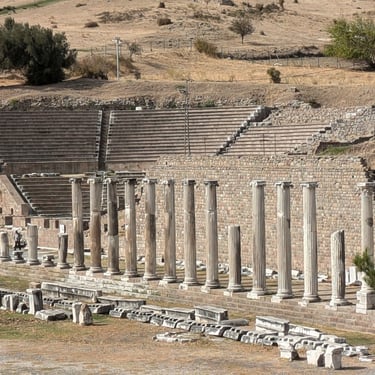
I left Istanbul and crossed into Asia Minor at the Dardanelles. The road south carried me along the Aegean coast, where I stopped to wander the ruins of ancient Troy. After a traditional lunch in a quiet mountain village, I toured the Asklepion, a Roman-era spa that still held the echoes of healing rituals. I liked passing through the smaller towns—life felt slower there.
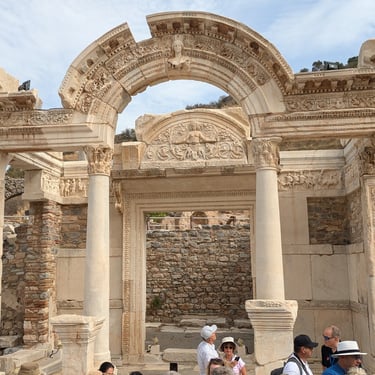
From the Asklepion, I continued to Izmir on the Aegean coast. A day trip took me into the ruins of Ephesus, crowded with cruise-ship tourists yet still impressive. The Ephesus Museum held treasures unearthed from the site, and later I visited the House of Mary in the mountains. Photos weren’t allowed inside, which somehow kept the space more reverent.
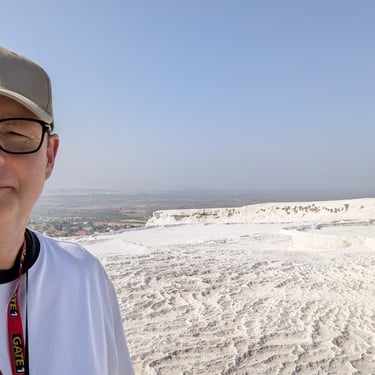
Departing Izmir early, I stopped at Pamukkale on the way to Antalya. The terraces of white salt reminded me of Mammoth Hot Springs in Yellowstone. Most of the group slipped into the thermal pool, but I preferred clambering through the ruins of Hierapolis and exploring its museum. The city had once been called the “Holy City,” and the Necropolis stretched out like a silent stone village.
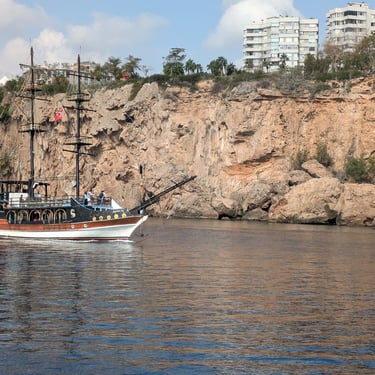
In Antalya, the Mediterranean heat wrapped around me. A city tour carried me through Hadrian’s Gate, past the Clock Tower, and along stone walls dating back to the 2nd century. Later, from the deck of a wooden boat, I saw rugged cliffs, waterfalls, and the coastline opening wide to the sea. At the Archaeological Museum, artifacts over 2,500 years old lined the halls, their sarcophagi astonishingly intact. A peacock strutted through the grounds, a living splash of color among the relics.
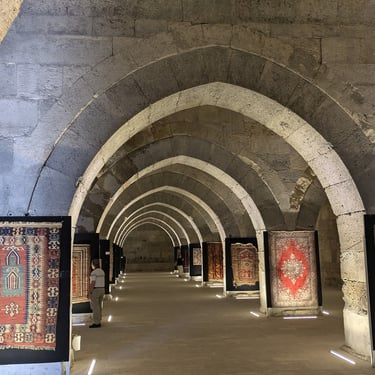
From Antalya, I drove northeast through the mountains toward Cappadocia, stopping at the Caravanserai of Sultanhan, once a shelter for Silk Road travelers. That evening, in Cappadocia, I sat quietly through a Whirling Dervish performance. I didn’t fully understand it, but I liked it.
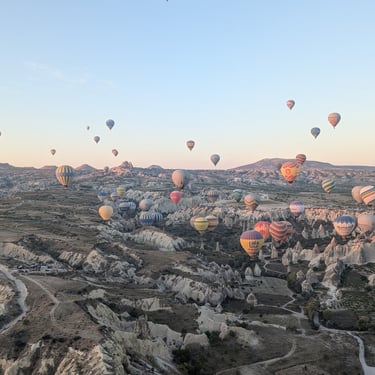
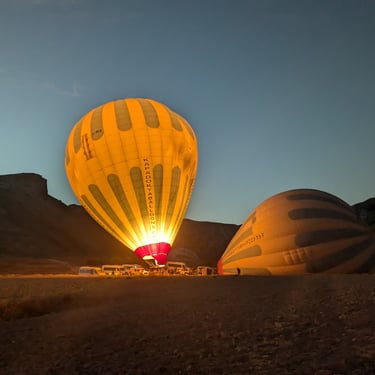
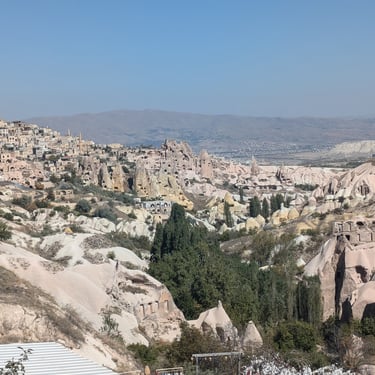
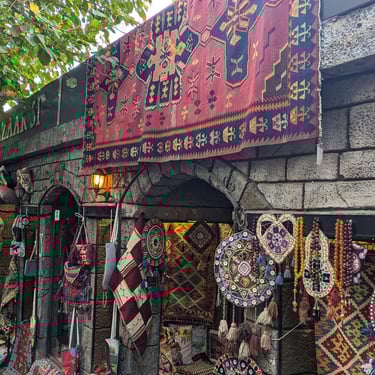
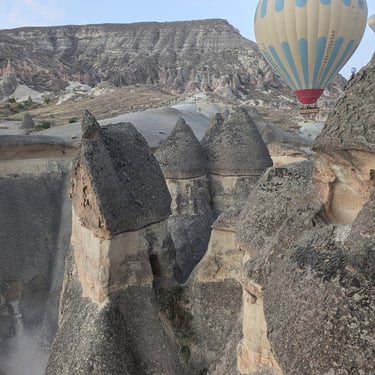
The next morning began before dawn. A hot-air balloon lifted me over the surreal Cappadocian landscape, its fairy chimney formations glowing in sunrise light. I’d dreamed of this ride ever since a balloon once crash-landed on the farm when I was a kid. Afterward, I explored the Goreme Valley’s Open-Air Museum with its rock-cut Christian churches, frescoes I couldn’t photograph but won’t forget. I descended into the Ozkonak Underground City, then ended the day watching a demonstration of Turkish carpet weaving at a local atelier. No carpets came home with me, but the memories did.
It was a packed journey, sometimes exhausting, but stitched together like a tapestry—ancient cities, mountain roads, sunlit coasts, and that one balloon ride that made it all worth it.

Erick Garrity, World Traveler, October 2024
Tuscany and Florence Italy
Tuscany is a breathtakingly beautiful region that effortlessly marries scenic landscapes, rich history, and renowned cuisine, making it an enchanting destination for mature travelers seeking a blend of relaxation and cultural exploration. Imagine driving through the rolling hills dotted with vineyards, olive groves, and sunflower fields, where each turn reveals a scene straight out of a postcard. This picturesque countryside offers a quiet, slower pace that feels like a step back in time, with quaint medieval villages, charming wineries, and family-owned trattorias where you can indulge in some of the finest wines and culinary delights in all of Italy.
Florence, Tuscany’s crown jewel, is a must-see for anyone with a passion for art, history, and architecture. Home to iconic Renaissance masterpieces, Florence offers travelers the opportunity to stand before Michelangelo’s David, gaze upon the grandeur of the Duomo, and wander the halls of the Uffizi Gallery, which houses works by Botticelli, Leonardo da Vinci, and Raphael. The city’s cobbled streets, lined with artisanal shops, vibrant markets, and cozy cafes, invite leisurely strolls, letting visitors take in the ambiance of one of Europe’s most historic cities. Climb up to Piazzale Michelangelo at sunset for sweeping views over Florence’s terracotta rooftops and the Arno River, a sight that is bound to leave you breathless.
Tuscany and Florence are also ideal destinations for those who value immersive experiences. In fact, consider joining Senior Travel Adventures 4/20-5/1/2025 on the trip of a lifetime with a specially curated smaller group tour.


Iceland is a bucket-list destination for travelers seeking the ethereal beauty of the Northern Lights. This Nordic island offers more than just a light show—it’s a wonderland of natural and cultural highlights.
Start your journey in Reykjavik, the vibrant capital, where modern charm meets Viking history. Don’t miss Hallgrímskirkja, the iconic church offering panoramic city views. From there, venture into the countryside to explore Iceland’s famous Golden Circle. Witness the explosive power of Geysir, marvel at the cascading beauty of Gullfoss waterfall, and walk between continents at Þingvellir National Park.
For an unforgettable experience, soak in the Blue Lagoon’s geothermal waters, surrounded by rugged lava fields. If you’re up for adventure, head to the South Coast to see the black sand beaches of Reynisfjara, the towering Skógafoss waterfall, and the glistening icebergs at Jökulsárlón Glacier Lagoon. The Sky Lagoon is a good alternative due to the volcanic activity.
Of course, the Northern Lights are the crown jewel. The best viewing happens from September to April, away from city lights. Join a guided tour or find a remote spot to watch the auroras dance across the Arctic sky.
Iceland’s unique landscapes, rich culture, and the magic of the Northern Lights make it a destination you’ll never forget.

Iceland!
Amsterdam
Amsterdam is a city that effortlessly blends history, art, and modern living, making it a must-visit destination for travelers. With its picturesque canals, world-class museums, and vibrant neighborhoods, there’s something for everyone in the Dutch capital.
Start your journey with a canal cruise to take in the city’s iconic waterways and charming gabled houses. Then, dive into history at the Anne Frank House, a moving tribute to resilience and hope. Art lovers will find inspiration at the Van Gogh Museum and the Rijksmuseum, home to masterpieces like Rembrandt’s The Night Watch.
Wander through the lively Jordaan district, known for its boutique shops, cozy cafés, and vibrant markets. For a peaceful escape, visit Vondelpark or explore the historic De Negen Straatjes (Nine Streets) for unique shopping and dining experiences.
No trip to Amsterdam is complete without sampling local delights like stroopwafels, herring, and Dutch pancakes. And if you’re visiting in spring, take a day trip to the Keukenhof Gardens to witness the breathtaking tulip fields in full bloom.
Whether you’re cycling along the canals, admiring centuries-old architecture, or soaking in the city’s rich culture, Amsterdam offers endless moments of wonder.


About
Contact
Submit a story
Senior Travel Adventures © 2024
Senior Travel Adventures is about empowerment, encouragement, and support to take the trip! We respect your privacy.
Please sign up for our newsletter below :
Terms & Conditions
Privacy policy
We care about your data in our privacy policy.