
Tales from the Danube
A Solo Traveler’s Journey from Vilshofen to Budapest
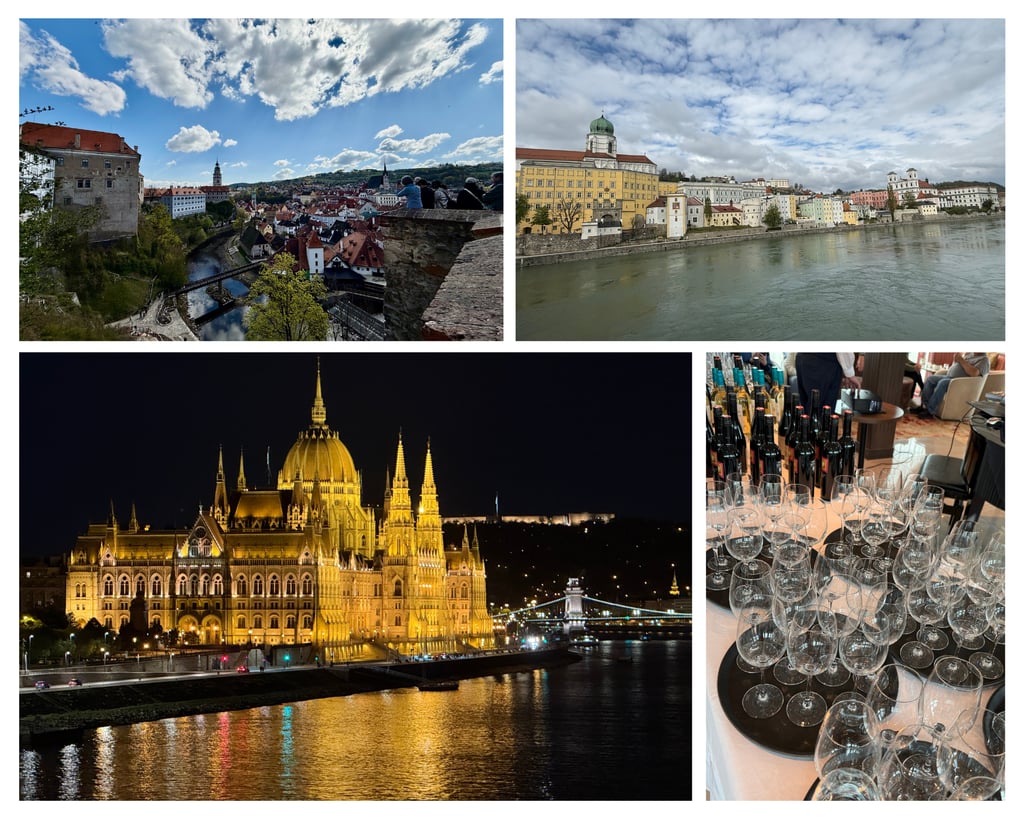
There is a moment, somewhere between Fresno and Munich, somewhere high over the Atlantic, when a trip stops being an itinerary and starts becoming something else entirely.
You feel it in the quiet hum of the cabin, in that first sip of something cold, in the realization that for the next stretch of days, your only job is to show up and experience what’s in front of you.
That moment came early for me on this journey, and it never really let go. The history of the region is so deep, too deep for a blog post, so I’ll touch the surface here.
The Getting There (and the Letting Go)
My route was simple enough on paper: Fresno to Munich via Denver, then a Lufthansa Express bus to the train station, followed by a train to Passau. But travel, as we know, is never just about logistics, it’s about transition and time… a lot of time – 24 hours door to door in this case.
That first train ride into Bavaria felt like crossing a threshold. The scenery softened, the pace shifted, and by the time I reached Passau for a quiet overnight stay, I had already begun to settle into that beautiful in-between space that travel creates, the one where you’re no longer tethered to home, but not yet anchored anywhere new. My room was comfortable, but not well lit, so that was a bit of a challenge. The few channels on the TV were not in English, so grateful for my iPad.
The next day, a local driver took me to Vilshofen, the starting point of my Danube River cruise. He was warm, talkative, proud of his town, and it showed. Vilshofen itself is one of those places that doesn’t try too hard. It doesn’t need to. It’s charming in a quiet, confident way. Known as the "Town of Three Rivers," is a gem of a place, quiet, charming, and home to the 19th-century Church of Saint John the Baptist.
Vilshofen: A Gentle Beginning
The ship welcomed me in that effortless way that good hospitality always does, like you’ve arrived somewhere you were meant to be.
And then there was Kata, our cruise manager. Gracious, grounded, and quietly exceptional at what she does. She set the tone for the entire journey, and it was no surprise to me that I found myself interviewing her later for my show. When someone elevates an experience like that, you share it.
Within an hour, I had toured the ship, settled into my cabin (upgraded to a balcony, one of those small travel miracles that never gets old), and met a handful of fellow solo travelers. Tim from the UK, Susan from Florida, Sandy from San Diego, and Lisa from Canada. There’s a particular kind of camaraderie among solo travelers, an openness that skips the small talk and goes straight to connection. For the first time on any solo trip, I did encounter a solo woman traveler who was quite abrupt and rude to others – and in the beginning of the trip at our first dinner. I was taken aback because that is not the norm and will chalk it up as an exception and chose to avoid her for the remainder of the trip.
Before sailing, I wandered into town, found a small market, and bought flowers for Kata’s desk. It’s a little ritual of mine to try and find ways of saying thank you before the journey even begins. I like to provide small gifts when possible, such as candy for flight attendants (never expecting anything in return) who truly appreciate the kindness.
That evening, the ship hosted a “Sip and Sail” event that turned out to be a full Oktoberfest celebration right on the dock. A live German band, children dancing, pretzels, local beer, it was joyful in that unfiltered, communal way that makes you feel like you’ve stepped into something authentic. I met a couple from Tulsa, both named Pat, which felt like exactly the kind of detail that travel loves to hand you. We became friends during the cruise, and I hope to cross paths with them again (like I have with so many others).
Dinner that night was easy, unforced, and full of that early-trip energy where everything still feels new. Everyone was excited to experience the menu.
The Wine (and Then Some)
This specific sailing was designated a “Celebration of Wine,” which, if you’re imagining a few extra pours at dinner, doesn’t quite capture it. The cruise was also called the “Romantic Danube” which was ironic for me as a solo traveler, but as it turned out just the moniker of the river and not the participants.
A “Celebration of Wine” cruise is a completely distinct experience from your typical river sailing, it’s not just wine served with meals, it is wine woven into the entire journey. Throughout the cruise, you’ll find curated tastings, exclusive vintages you might not easily find at home, and thoughtfully paired dinners where each course is designed to highlight specific wines.
These themed departures bring a winemaker onboard, and we were joined by Roman Roth, the winemaker from Wölffer Estate Vineyard, Long Island, NY, who arrived with 25 cases of wine and a deep, generous knowledge of his craft. For more than three decades, Wölffer Estate Vineyard has built a reputation as one of the East Coast’s standout producers, known not just for its wines, but for its spirit of innovation and hospitality. Founded in 1988 by Christian Wölffer, it spans vineyards in the Hamptons, the North Fork, Argentina, Spain, and France, yet still maintains a clear focus: crafting distinctive wines that reflect both place and personality. Over the course of the week, Roman led tastings, hosted a beautifully paired winemaker’s dinner, and brought a kind of storytelling to the experience that elevated every glass. One of my favorites was the Cabernet Franc, and of course their signature “Summer in a Bottle” rose.
What I appreciated most was how approachable he made it. This wasn’t about pretension; it was about understanding. About slowing down enough to notice what you’re tasting, what you’re pairing, what you’re experiencing in the moment. He was amusing, told great stories, and is even a great singer!
Somewhere along the way, wine stopped being just something I enjoyed and became something I paid attention to – taking the time to do the “cha cha cha” a term he shared with us – the time to swirl, sniff, and savor.
And yes, I may have embraced this theme a little enthusiastically. I am always a lightweight drinker, but if there’s ever a place to be “overserved”, it’s on the Danube.
Passau and Linz: History in Layers
One delightful discovery: the Danube isn't called the Danube in the countries it flows through. In Germany, it's the Donau, in Hungary is the Duna. In fact, most countries do not call it the Danube at all!
We sailed overnight to Passau, a town defined by its geography, the meeting point of three rivers, and its history, which seems to live in every archway and cobblestone. Passau sits precisely on the Austrian border at the confluence of three rivers: the Danube, the Inn, and the Ilz, and its history as a medieval trading port for salt and swords is written into every stone alley and arched doorway.
The crown jewel is Saint Stephen's Cathedral, home to an organ with almost incomprehensible 17,000 pipes. It is also, apparently, known for its beer, though we didn't make it to a brewery.
There’s something grounding about places like this. You’re reminded that life has been unfolding here for centuries, long before you arrived with your camera and your curiosity. We were told a story about a young child who saved the life of his young friend on the banks of the Danube in Passau. The friend he saved that day was Hitler, a decision that this man struggled with his entire adult life having entered the Priesthood.
Linz, our next stop, carried a different energy, lighter, more contemporary, but still deeply rooted. Walkable, welcoming, and quietly confident. The capital of Upper Austria styles itself the "City of Peace," and it has a gentle, walkable energy that earns the label. Its most photographed landmark is the Holy Trinity Column, a baroque masterpiece in the center of town. But it was the food history that captivated me most: the Linzer torte, created here in 1653, is considered the oldest cake recipe in the world. Mozart composed his Linz Symphony and the Linz Sonata during a brief stopover here, swiftly, apparently, as composers under pressure tend to do.
From there, I chose an excursion to Český Krumlov in the Czech Republic, a decision I didn’t second-guess for a moment. The town is a UNESCO World Heritage treasure, its medieval old town wrapped in a bend of the Vltava River, with a castle complex looming above. The alternative was Salzburg, but I will visit that in the future.
I only wish we'd had more time in Linz, there was an old monastery on a hill you could reach by tram that I simply had to leave behind. It will haunt me.
I also had what might have been the most memorable meal of the trip in Český Krumlov: blueberry dumplings, warm and soft, covered in butter, powdered sugar, and sweet cheese, at the recommendation of our local guide. Simple, indulgent, and completely unforgettable. I could only manage one, but it was enough.
Wachau Valley: Slowing Down
Weissenkirchen brought a shift in pace. Smaller, quieter, surrounded by vineyards, it felt like the river itself had exhaled. Weissenkirchen is a village of about 2,000 souls that has committed entirely to wine, and good for it. This is the Wachau Valley in its quietest, most pastoral form. Sleepy and gorgeous.
Grüner Veltliner and Riesling are the stars here, and the landscape reflects it, orderly rows of vines, soft hills, and a rhythm that encourages you to slow down whether you planned to or not.
From there, I visited Melk Abbey, perched high above the Danube. Its exterior is striking, its setting dramatic, and while parts of the interior felt familiar after days of ornate architecture, the Benedictine church itself was undeniably breathtaking.
Krems followed, with a visit to Schloss Gobelsburg for a wine tasting and cellar tour that was both elegant and relaxing. The vineyards unfold in every direction around the castle, each one shaped by its own microclimate and personality. From the sun-soaked terraces of Zöbinger Heiligenstein and Gaisberg to the sweeping grounds surrounding Gobelsburg, every plot is carefully matched to the grape it grows—giving each variety exactly what it needs to thrive, express itself, and reach its full potential. After the formal tasting, I slipped back into the tasting room and tried one of their ice wines, something I hadn’t had in years. It was spectacular.
And, as it turns out, not something you easily bring home. Some experiences are meant to stay exactly where you find them. Carrying wine home isn’t a great idea.
Vienna: Movement and Momentum
Vienna is a city that knows exactly who it is. Imperial, musical, structured, and proud of it.
I joined a walking tour that covered the essentials, St. Stephen’s Cathedral, the Opera House, the Hofburg, but what stayed with me most was what happened after the tour ended.
I kept walking, and walking…
21,000 steps later, I had seen Vienna in a way that felt personal. Not just the landmarks, but the spaces in between them. The rhythm of the city. The way it unfolds when you give it time.
I did manage to eat a Bratwurst from a street vendor – the idea better than the actual item, which was dry and tasteless. Disappointing, but at least I tried.
That evening, some of the group attended a concert at the Opera House. I didn’t. And if there’s one piece of advice I’d offer from this trip, it’s this: if Vienna offers you music, take it. I would have gone just to see the venue.
Esztergom: A Quiet Introduction to Hungary
Esztergom was a softer landing into Hungary, less visited, less crowded, but deeply significant. As the former capital and the seat of the Hungarian Catholic Church, it carries a quiet weight.
It was also where I was introduced to Tokaji, Hungary’s famous dessert wine, rich, golden, and completely distinct from the wines we’d been enjoying earlier in the trip.
From there, we made our way into Budapest.
Budapest: The Stay That Changed Everything
When the cruise ended, I stayed on. And that, more than anything, enhanced the entire experience.
I navigated the city mostly by tram, efficient, easy, and one of those small pleasures that makes you feel like you’ve figured something out. My stay at the Kimpton BEM Budapest came with an unexpected upgrade to a suite with soaring ceilings and a freestanding bathtub, a moment that felt like a quiet reward for saying yes to the trip in the first place.
Budapest isn’t a city you rush. It’s one you move through, slowly, curiously, letting it reveal itself in layers. Buda and Pest, divided by the Danube, connected by bridges that feel like landmarks in their own right. Budapest didn’t just impress me—it pulled me in.
After the structure of the cruise, arriving here felt different. Less guided, more personal. This was where I got to wander, to linger, to follow my own curiosity, and that’s when a place really starts to speak to you.
The city itself is a study in contrast. Buda and Pest sit across from each other like two personalities sharing the same story, Buda, quieter and more historic, rising into Castle Hill: Pest, vibrant and energetic, stretching out with wide boulevards and a hum of everyday life. And connecting it all is the Danube, broad, steady, and somehow always the center of everything.
I found myself drawn to the river repeatedly.
Walking along the Danube promenade, the scale of the Hungarian Parliament Building stopped me in my tracks more than once. It’s not just large, it’s commanding. The kind of building that makes you pause, look up, and feel exceedingly small in the best possible way. Every angle seems designed for drama, especially as the light changes throughout the day.
But not all moments here are grand.
Standing at the Shoes on the Danube Bank was one of the most sobering experiences of the trip. Sixty pairs of iron shoes lined along the river’s edge...simple, quiet, and deeply powerful. There’s no spectacle, no distraction. Just a space that asks you to stop, reflect, and remember. It’s one of those places that shifts your entire mood in an instant.
And then, just a short distance away, life continues.
Trams glide by. Locals chat at cafés. The rhythm of the city doesn’t stop, it absorbs its history rather than separating from it. That layering is what makes Budapest so compelling. It doesn’t present itself as one thing. It holds everything at once, beauty, tragedy, resilience, and movement.
Up on Castle Hill, I took in the sweeping views from Fisherman's Bastion, a place that feels almost dreamlike with its turrets and terraces. From there, the entire city unfolds beneath you. The Danube cutting through it, the bridges linking both sides, the Parliament standing proudly across the water. It’s the kind of view that makes you linger longer than you planned.
Nearby, Matthias Church adds its own personality with that colorful tiled roof and layered history. It’s one of those landmarks that feels both ornate and grounded at the same time, deeply tied to the identity of the city.
I visited The Cave Church (Sziklatemplom), also known as the Gellért Hill Cave, which is a unique grotto chapel carved directly into the rock of Gellért Hill in Budapest at the recommendation of Pat #1. It was amazing.
But what stayed with me just as much as the landmarks were the smaller, everyday moments.
Riding the tram is simple, efficient, and honestly one of my favorite ways to experience a city. There’s something about sitting among locals, watching neighborhoods shift outside the window, which makes you feel like you’re part of the place rather than just passing through. And yes, if you’re over 65, it’s free… which feels like a little bonus gift from Budapest itself.
I also spent hours just walking, no real destination, just letting the city unfold. I visited the Great Market Hall, which was filled with colorful produce, raw meat, prepared food, and of course Chimney Cake! I had it in the purest form, cinnamon with no filling!
Side streets, tucked-away cafés, glimpses of architecture that catch your eye when you least expect it. Budapest rewards that kind of exploration. It doesn’t demand a checklist, it invites curiosity.
One of my favorite experiences was a walking tour with a local guide whose passion for the city was contagious. What was supposed to be a couple of hours stretched into four, and no one noticed. That’s when you know it’s good. We talked about history, culture, and film (Budapest is a surprisingly big filming location), and even the possibility that Tom Cruise might be somewhere nearby. I didn’t spot him, but I did see a film crew setting up for “The Day of Jackal” which felt like its own little behind-the-scenes moment.
And then there was the evening. I took a river cruise just as the light was beginning to fade. At first, everything was softly lit, almost understated. But as dusk settled in, the city transformed. The Parliament building illuminated, the bridges glowing, the reflections dancing on the water, it was one of those slow, cinematic transitions that you don’t rush. You just sit with it.
Later that night, walking back across Margaret Bridge, I stopped halfway and turned back toward the city. That view, fully lit, alive, and reflected in the river, was the one I’ll carry with me. It was mesmerizing from every angle.
Budapest isn’t just beautiful. A lot of cities are beautiful.
Budapest feels something.
It invites you to experience it fully, to walk, to pause, to learn, to reflect, and then to keep going. And as a solo traveler, I felt completely at ease doing exactly that.
I walked along the Danube, stood in front of the Parliament building, and paused at the Shoes on the Danube Bank, a place that shifts the tone of your day instantly. Sixty pairs of iron shoes, a stark and powerful reminder of lives lost during World War II.
Budapest holds its history close. It doesn’t hide it. And because of that, the city feels layered in a way that’s both beautiful and humbling.
Sometimes the best moments aren’t the planned ones. They’re the ones you almost walk past.
The Takeaway
There’s something about river cruising that just feels… right. It’s not about rushing from place to place—it’s about gliding through a story as it unfolds. You unpack once, settle in, and let the landscape come to you, vineyards, villages, castles with each one arriving like a new chapter outside your window.
Sailing with AmaWaterways on the AmaBella made that experience even more special. The ship itself felt intimate and welcoming, never overwhelming, with spaces that encouraged connection, whether that was over dinner, a glass of wine on the Sun Deck, or those unplanned conversations that somehow become the highlight of your day. The crew knew your name, your preferences, and often your coffee order before you even asked.
What I loved most was the rhythm of it all. Mornings waking up in a new destination. Afternoons exploring. Evenings returning “home” to a beautifully prepared meal and familiar faces. It’s travel that feels both effortless and deeply enriching at the same time.
River cruising doesn’t shout for your attention. It quietly wins you over, and before you know it, you’re already thinking about where it might take you next. I think river cruising merges the best of travel worlds.
And so it ends…
If you’ve followed my travels for a while, you know I’ve long considered London my favorite city.
Budapest is now a very close second.
This journey, from the Donau to the Danube, wasn’t just about the destinations. It was about the rhythm of moving through them. The people I met. The conversations that unfolded over dinner. The unexpected moments that became the ones I remember most.
And as a solo traveler, I felt something that matters deeply to me: Ease. Comfort. Safety. Connection.
So if you’re considering a Danube River cruise, I’ll say this, go. If you’re considering adding time in Budapest, absolutely go.
And if you’re waiting for the “right time” to take a trip like this… consider this your sign.
Because somewhere over the Atlantic, with a glass in hand and a new story waiting, you’ll realize:
Adventure doesn’t retire…It rewires..
If you’d like your own special Danube experience, I’d love to help you create your own adventure – deborah.dotson@fora.travel at your service!
Note: I use an AI Editor.
About
Contact
Submit a story
Senior Travel Adventures © 2024
Ageless Adventures is about empowerment, encouragement, and support to take the trip! We respect your privacy.
Please sign up for our newsletter below :
Terms & Conditions
Privacy policy
We care about your data in our privacy policy.